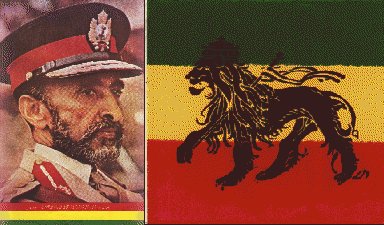
| Prince Ital Joe's press biography claims that "...his involvement with the Rastafarian movement has given [him] a sense of pride and a godly outlook on life..." But what exactly is the Rastafarian movement? |
SPEECH BY H.I.M. HAILE SELASSIE I,
CALIFORNIA 28TH FEBRUARY 1968.
 "Last May, in Addis Ababa there was convened a meeting of Heads of African States and Governments. In three days, the thirty-two nations represented at that Conference demonstrated to the world that when the will and the determination exist, nations and peoples of diverse backgrounds can and will work together in unity for the achievement of common goals and the assurance of that equality and brotherhood which we desire."
 "Although our position vis-a-vis the power-blocs is identified with the policy of non-alignment, our past history testifies to the fact that we have always endeavored to cooperate with all nations, without exception. Thus, one of the fundamental principles we have agreed upon at the Addis Ababa Summit Conference gives expression to our fundamental desire to live in harmony and cooperation with all States."
"On the question of racial discrimination, the Addis Ababa Conference taught, to those who will learn, this further lesson:"
"that until the philosophy which holds one race superior and another inferior is finally and permanently discredited and abandoned; that until there are no longer any first-class and second-class citizens of any nation; that until the color of a man's skin is of no more significance than the color of his eyes; that until the basic human rights are equally guaranteed to all, without regard to race -- until that day, the dreams of lasting peace and world citizenship and the rule of
 international morality will remain but a fleeting illusion, to be pursued but never attained. And also, that until the ignoble and unhappy regimes that hold our brothers in Angola, in Mozambique and in South Africa in subhuman bondage have been toppled and destroyed; until bigotry and prejudice and malicious and inhuman self-interest have been replaced by understanding, tolerance and good-will; until all Africans stand and speak as free beings, equal in the eyes of all men as they are in Heaven -- until that day the African continent will not know peace. We Africans will fight, if necessary and we know that we shall win, as we are confident in the victory of good over evil."
 "The United Nations has done much, both directly and indirectly, to speed the disappearance of discrimination and oppression from the earth. Without the opportunity to focus world opinion on Africa and Asia which this Organization provides, the goal might, for many, still lie ahead, and the struggle would have taken far longer. For this we are truly grateful."
Rastafari Movement
| Doctrines | The Rastafaris draws their beliefs from the bible which they believe to have been incorrectly translated from the Aramaic and, for that reason, to contain some mistakes. They believe that through experience and intuition they can interpret it correctly and discern its truth. Central to their belief is the doctrine that black people are descendants of the early Israelites and that they were exiled because of their transgressions. Their salvation will come, however, through Haile Selassie I., who, they believe, is God and their saviour, the incarnation of Jah -or Jehovah, the reincarnation of Christ, the one who will bring them to the Land of freedom, to Africa. For them, Africa and, more precisely Ethiopia, is the home of Black people, the place where they can be saved. Salvation comes through repatriation. The meaning applied to repatriation varies among the believers. For some it means a physical return to Africa; others, however, think that the return to Africa does not need to be a physical return; most important is to become aware of their African identity, to re-establish their identity undermined by the different kinds of power, and to immediately start changing their reality right where they are. Although they believe in reincarnation they are not concerned with the after life, as salvation happens here in their search for their home, in the search for Africa which is for them associated with heaven, while Babylon (that is the place of the white man, the white society) is associated with hell. To be a rasta is to live in accordance with the laws of nature, in other words is to live in an African way. In their diet they avoid meat, and above all, pork, alcohol, and food of unknown sources. There is no obligation to attend rituals. They have, however collective reasoning sessions called nyahbinghi. In these sessions they reflect on the bible and on their history, as well as on the nature of God, destiny, and among other things the meaning of life. In order to achieve discernment in these sessions, some of them make use of the ganja (marijuana). There are no strict rules concerning the use of ganja. However, according Rastafarians, the overuse of it might turn into an end in itself, which would be contrary to the aim of the group. So it should be used only in certain occasions. Family life is very important and though marriage may not be formalized in the western Christian way, it is taken very seriously. Women, however, seem to have a lesser role in the movement as a whole. The family structure is a patriarchal one and therefore woman is subordinated to man, though she might, often, be the earner of the house. Abortion and contraception are forbidden. For them it is important not just to believe in God, but to know God. To be a rasta is to live a process from believing to knowing, from knowing to experiencing. The importance of experience can be clearly perceived in their language, used as a tool of individual and group identity and awareness. An example of this can be seen in their use of the pronoun "I" that many times replace "me", or "you" or even radicals in words. so they may say "I and I" meaning "we". This reminds them of the awareness of oneself, of the awareness of being God. | |
| History | In 1517 Jamaica started importing African slaves. Unhappy with their condition, many slaves escaped and began revolting against their white master. Even after the abolition of slavery many black people remained unhappy with the miserable condition of their life, and nourished a desire to go back to Africa. This desire started to take shape with movements concerned with the condition of black people. Marcus Garvey, considered a prophet by the rastas, had already formed in 1916 the UNIA (Universal Negroe Improvement Association). In 1929 he prophesied that redemption would come when a black king , descending from the lineage of David, would be crowned. This prophecy was confirmed when on november the second 1929 Negus Tafari - said to be descendent from the King David- was crowned king of Ethiopia, receiving the name of Haile Selassie I. with the enthronement of Haile Selassie I the rastafari movementwas inaugurated. Soon after the enthronement Leonard Howell, Joseph Hibbert, Archibald Dunkley, Robert Hinds and other members of the UNIA, decided to follow Haile Selassie as his disciples, and established the Rasta doctrine.[ After the Rastafari movement had started in the early1930s, Haile Selassie created in 1937 the Ethiopian World Federation (E.W.F.) and in 1938 opened a branch in Jamaica giving a considerable impulse to the movement. By 1940 Howell had established the first Rasta community at Pinnacle, Jamaica. In 1954 this community was dismembered by the police, which, in fact contributed to the dissemination of rastafari ideas. After Haile Selassie's visit to Jamaica the doctrine of expatriation came to be regarded as a spiritual rather than literal expatriation, and the movement developed a more active, political role in Jamaica. Despite Haile Selassie's death in August 1975, rastas believe that he is istil alive as he has always been. In the course of time the movement spread from Jamaica to other partes of the world such as The United States and Europe. Artists and musicians have played a very important roll in this process, either influencing politicians inside Jamaica or promoting the movement in other countries. | |
| Symbols | The dread locks are one of the ways Rastas use to emphasize their identity. It is related to the Lions and inspired on the bible. Of particular importance to the Rastafarians are the colours gold, red, green, and black (the colours of the Ethiopian flag) which they use to identify themselves. | |
| Adherents | It is estimated that there are some 100,000 Rastafarians in Jamaica (Harris et al. 1994, 197). There are also Rastafarians in Great Britain, the United States, and eslewhere in the Caribbean. It is not known how large these communities are. | |
| Headquarters/ Main Centre | Kingston |


No comments:
Post a Comment